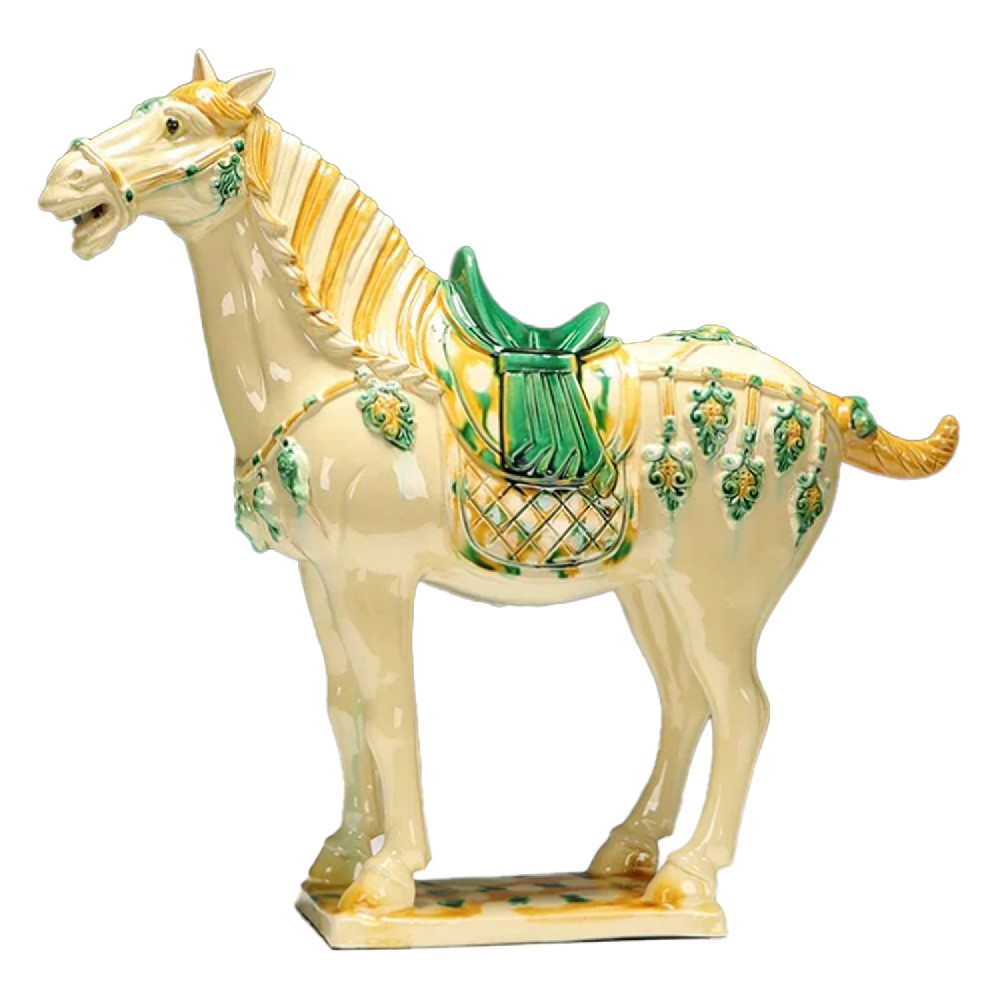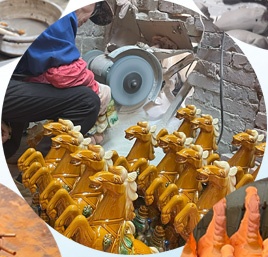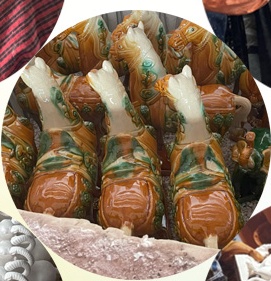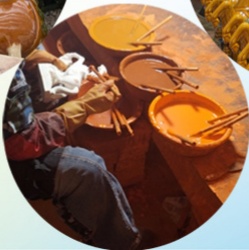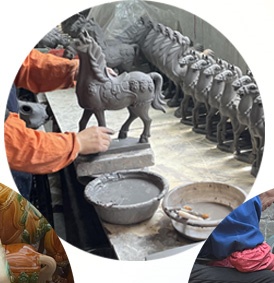
After the bisque firing, the brick-red or light pink clay body is ready to receive its most distinctive feature: the flowing, luminous tri-colored glaze. The preparation of Tang Sancai glazes is a delicate art that combines chemical knowledge, empirical experience, and artistic sensibility.
The Basic Composition of Tang Sancai Glaze
Tang Sancai glazes are low-temperature lead glazes. Their basic formula consists of three essential components:
1. Flux – Lead Oxide (PbO)
Lead oxide is the most critical ingredient. It lowers the melting point of the glaze to approximately 800–900°C, allowing it to melt and flow freely on the clay body without melting the body itself. Without lead, the glaze would require temperatures above 1200°C to melt — temperatures that would deform or destroy the clay body. Traditional lead sources included red lead (Pb₃O₄) or litharge (PbO), which were finely ground before use.
2. Glass-Former – Silica (SiO₂)
Silica, typically sourced from finely ground quartz sand or quartzite, forms the structural backbone of the glaze. When melted, silica creates a glassy network that gives the glaze its hardness, durability, and luster.
3. Stabilizer – Clay (Al₂O₃·2SiO₂·2H₂O)
A small amount of clay (usually the same white clay used for the body) is added to the glaze mixture. The clay helps suspend the other ingredients in water, prevents the glaze from cracking during drying, and provides alumina, which stabilizes the glaze and prevents it from running off the body entirely.
Coloring Agents – The Source of the "Three Colors"
The rich palette of Tang Sancai comes from the addition of metal oxides to the basic lead-silica glaze. Each oxide produces a distinct color:
| Coloring Oxide | Produced Color | Notes |
|---|---|---|
| Iron oxide (Fe₂O₃) | Yellow, amber, brown | Varies with concentration and firing atmosphere |
| Copper oxide (CuO) | Green, turquoise | The most common green in Tang Sancai |
| Cobalt oxide (CoO) | Blue | Rare and precious; imported from Persia |
| Manganese dioxide (MnO₂) | Purple, brownish-purple | Less common, used for accents |
| Antimony oxide (Sb₂O₃) | Yellow (bright) | Occasionally used for specific yellow tones |
The famous phrase "blue is noble among the three colors" reflects the rarity of cobalt-blue glazed pieces. Cobalt was imported along the Silk Road from Persia, making blue-glazed Tang Sancai significantly more expensive and prestigious than pieces without blue.
The Preparation Process
Step 1: Raw Material Processing
Each raw material must be prepared individually before mixing:
Lead oxide and quartz: These are ground separately in stone mortars or on grinding plates until they pass through a 200-mesh sieve (finer than flour)
Clay: The clay is dried completely, crushed, and sieved to 150–200 mesh
Coloring oxides: Metal oxides are ground extremely fine; any coarse particles would create dark specks in the finished glaze
Step 2: Proportioning
Traditional formulas vary by kiln and period, but a typical recipe might be:
60–70% lead oxide (flux)
20–30% quartz (glass-former)
5–10% clay (stabilizer)
1–5% coloring oxides (for colored glazes)
These proportions are measured by weight with great precision. Ancient artisans used small brass or stone scales, and the recipes were often kept as closely guarded family secrets, passed down through generations.
Step 3: Dry Mixing
The measured dry ingredients are thoroughly mixed together. For a single color, all components are combined at once. For multi-colored effects, separate batches are prepared for each color.
Step 4: Wet Milling
The dry mixture is placed in a stone or porcelain ball mill with water (approximately 40–50% water by weight). The mixture is ground together for 24–72 hours, depending on the fineness required. The goal is to achieve a uniform suspension where every particle is less than 10 microns in diameter.
Step 5: Viscosity Adjustment
After milling, the glaze slip (a liquid suspension) is tested for viscosity. If too thick, it will not flow evenly; if too thin, it will run off the body. The viscosity is adjusted by adding water or a small amount of gum arabic or gum tragacanth (natural plant binders), which improves brushability and adhesion to the bisque body.
Step 6: Aging
Like the clay body, prepared glaze slip is often aged for several weeks. Aging allows the glaze components to fully hydrate and interact, resulting in a smoother, more predictable melt during firing. Some traditional kilns aged their glazes for months or even a year before use.
Special Glaze Types
White Glaze
White is not truly a "color" but the absence of added coloring oxides. The white glaze relies on the natural color of the lead-silica-clay mixture, which fires to a translucent ivory or pale cream. To achieve a purer white, artisans sometimes added a small amount of tin oxide as an opacifier.
Blue Glaze
Blue glaze required imported cobalt oxide, making it the most expensive. The cobalt was ground extremely fine and added to the base glaze in concentrations of 0.5–2%. Too little cobalt produced a pale blue; too much caused dark, almost black patches.
Fugitive Colors
Some Tang Sancai glazes, such as certain reds and purples, are "fugitive" — they are highly sensitive to firing conditions and easily burn out or turn brown. The presence of these rare colors on surviving pieces indicates exceptional skill and favorable kiln conditions.
Quality Control
Before glazing actual pieces, artisans test each batch of glaze on small test tiles. These tiles are fired alongside production pieces, allowing the potter to verify:
Melt temperature and flow characteristics
Final color and consistency
Fit with the clay body (no crazing or peeling)
Resistance to devitrification (cloudiness or crystallization)
Only after passing these tests is the glaze approved for use on finished pieces.