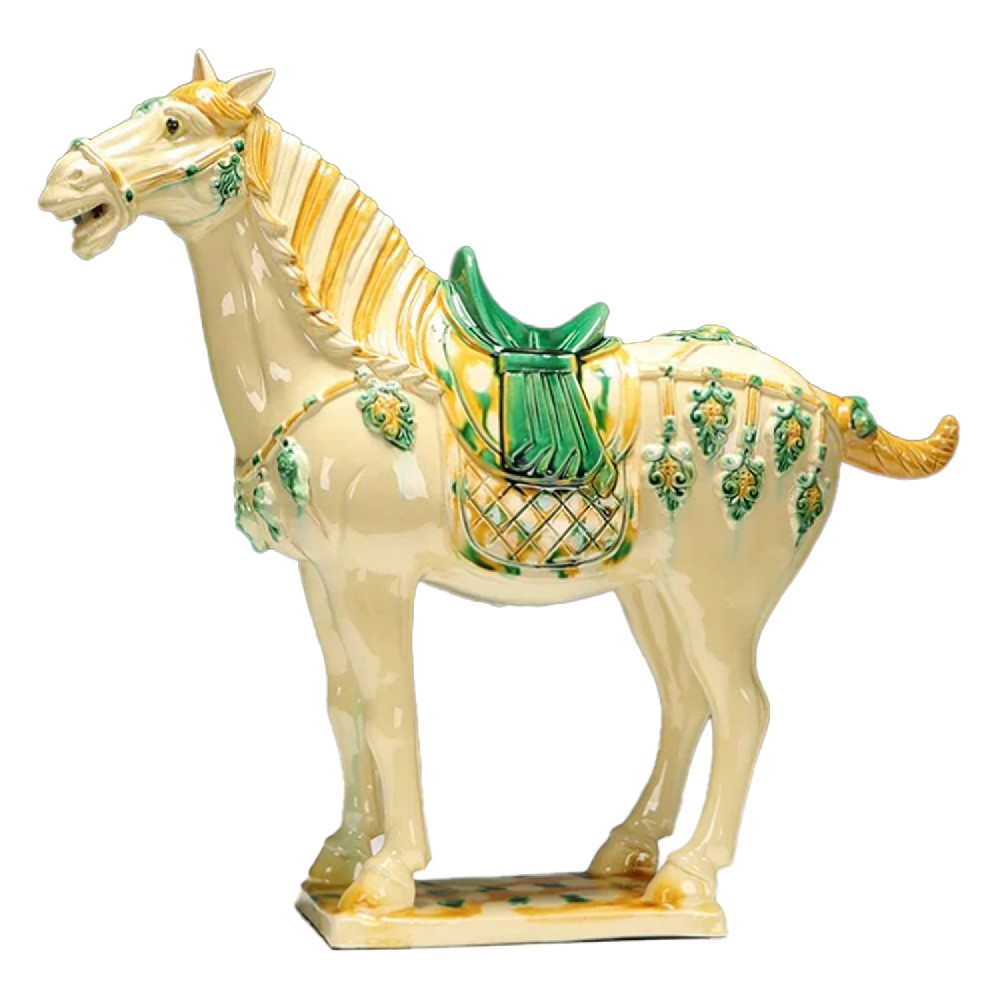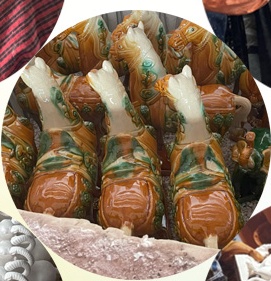
The application of glazes is complete. The glazed pieces, now covered in a dusty, matte layer of colored powders suspended in a clay-water mixture, are ready for their final transformation. It is in the kiln that the magic happens — where dull, opaque powders melt into brilliant, flowing glass, and where the iconic "three colors" of Tang Sancai are born.
Preparing for the Firing
Loading the Kiln
Kiln loading is a critical operation that requires careful planning:
Kiln furniture: Pieces are placed on refractory supports (saggars or stilts) to prevent them from sticking to the kiln floor or to each other. The feet of figures, left unglazed, rest directly on these supports.
Spacing: Each piece must have sufficient space around it for the glaze to flow freely. If pieces are too close, flowing glazes from adjacent pieces may fuse together.
Positioning: Flat pieces (dishes, tiles) are typically fired horizontally. Tall pieces (figures, vessels) are set upright. Some artisans tilt pieces slightly to encourage glaze flow in a desired direction.
Protective saggars: High-quality pieces are often placed inside clay saggars — closed or semi-closed refractory containers that protect them from direct flame, flying ash, and temperature fluctuations inside the kiln.
The Kiln
Traditional Tang Sancai was fired in various kiln types, including:
Mantou kilns (domed kilns) : Common in northern China, these were dome-shaped brick kilns with a single firebox at the front
Dragon kilns: Long, sloping tunnel kilns typical of southern China, though less common for Tang Sancai
Small bottle kilns: Used for smaller batches of high-quality pieces
Modern artisans often use gas or electric kilns, which provide more precise temperature control and cleaner firing atmospheres.
The Firing Process
Phase 1: Water Smoking (Room Temperature to 300°C / 572°F)
Duration: 2–4 hours
Rate of rise: Very slow, approximately 50–100°C per hour
What happens: Remaining water in the glaze coating evaporates. If heated too quickly, steam formation will crack the glaze layer (a defect called "steam popping" or "blistering")
During this phase, kiln vents are often left partially open to allow moisture to escape.
Phase 2: Decomposition (300°C to 600°C / 572°F to 1112°F)
Duration: 2–3 hours
Rate of rise: Moderate, approximately 100–150°C per hour
What happens:
Organic binders (gum arabic, etc.) burn out completely
Clay minerals in the glaze decompose, losing their chemically combined water
Carbonates and other volatile components break down, releasing gases
If the temperature rises too rapidly during this phase, trapped gases can create pinholes or bubbles in the finished glaze.
Phase 3: Sintering and Melting (600°C to 800–850°C / 1112°F to 1472–1562°F)
Duration: 2–3 hours
Rate of rise: Slow to moderate
What happens:
At about 600°C, the glaze particles begin to stick together (sintering)
At about 650–700°C, the lead oxide begins to melt, forming a liquid phase
The liquid phase progressively dissolves the quartz and other solid particles
At approximately 800–850°C, the glaze is fully melted and mobile
This is the most visually dramatic phase. As the temperature crosses 700°C, the previously matte, powdery glaze begins to glisten. By 800°C, it flows like honey, with different colors spreading, overlapping, and mixing.
Phase 4: Soaking (Holding Temperature)
Duration: 30–90 minutes
Temperature: Maintained at the target peak temperature (typically 820–850°C)
What happens: The glaze is held at its peak temperature to allow:
Complete melting of all glaze components
Equalization of temperature throughout the kiln
Full development of colors from metal oxides
Desired degree of flow and blending
The soak time is adjusted based on the desired effect. Longer soaks produce more flow and blending; shorter soaks yield sharper boundaries between colors.
Phase 5: Cooling
Duration: 8–24 hours (to room temperature)
Rate: Initially, very slow; after the glaze solidifies, the rate can be increased
Critical ranges:
800°C to 550°C: Very slow cooling (50°C per hour or less) — this prevents thermal shock cracking
550°C to 300°C: Moderate cooling
Below 300°C: Can be allowed to cool naturally with the kiln
If the kiln is opened while the pieces are still above 200°C (392°F), the sudden intrush of cold air can cause immediate cracking.
The Chemistry of Color Development During Firing
The colors of Tang Sancai are not simply "painted on" — they develop chemically during the firing process.
| Oxide | Before Firing | During Firing | Final Color |
|---|---|---|---|
| Copper (CuO) | Black or dark green powder | CuO + silica → copper silicate | Green to turquoise |
| Iron (Fe₂O₃) | Reddish-brown powder | Fe₂O₃ dissolves in lead glass | Yellow to amber |
| Cobalt (CoO) | Black powder | CoO dissolves, forming cobalt silicate | Deep blue |
| No oxide | White or cream powder | Pure lead-silica glass | Translucent ivory |
The firing atmosphere (amount of oxygen present) also affects colors:
Oxidizing atmosphere (plenty of oxygen): Copper produces bright green; iron produces yellow to amber
Reducing atmosphere (limited oxygen): Copper can produce red; iron can produce olive or brown
Tang Sancai was typically fired in an oxidizing atmosphere, which produces the characteristic bright, clear colors.
The Art of Flow: Controlling the Uncontrollable
The flowing glaze effect that makes Tang Sancai so distinctive is both the goal of the potter and the hardest variable to control.
Factors Affecting Glaze Flow
| Factor | Effect on Flow |
|---|---|
| Glaze composition | More lead = more flow; more clay = less flow |
| Glaze thickness | Thicker = more flow |
| Peak temperature | Higher = more flow |
| Soak time | Longer = more flow |
| Piece orientation | Tilted = directional flow |
| Kiln position | Top of kiln (hotter) = more flow than bottom |
Desired and Undesired Results
A successful firing produces:
Smooth, glossy surfaces
Sharp details (eyes, fingers, mane lines) still visible under the glaze
Colors true to their intended hues
Flowing where desired (saddles blending into legs, robes blending into sleeves)
No adhesion to kiln furniture
Firing defects include:
Excessive flow: Glaze runs off the piece entirely or pools in thick, cracked puddles
Insufficient flow: Glaze remains matte, rough, or unmelted
Color burn-out: Metal oxides over-fire, leaving pale or colorless areas
Devitrification: Glaze crystallizes during slow cooling, becoming cloudy or matte
Crazing: Fine cracks in the glaze due to mismatch between glaze and body expansion
Shivering: Glaze flakes off because it contracts less than the body upon cooling
Unloading the Kiln
After the kiln has cooled completely (typically after 24 hours or more), the kiln door is opened. This moment of revelation — seeing the finished pieces for the first time — is the climax of the entire process. The brick-red bisque bodies have been transformed. Where dull grayish powders once sat, brilliant greens, warm ambers, and creamy whites now shine. In some pieces, colors have flowed together like watercolors on wet paper; in others, sharp boundaries remain, as precise as the moment they were brushed on.
Each piece is carefully removed, the kiln furniture separated, and any attached kiln supports carefully chipped away from the unglazed foot.
Post-Firing Treatment
Some Tang Sancai pieces receive additional treatment after firing:
Polishing: Un-glazed areas (feet, interiors) are sometimes lightly polished with a stone or cloth
Cold-painting: In rare cases, details were added with cold pigments after firing, though these have usually faded or worn away over time
Repair: Chips or minor damage are sometimes filled, though authentic repairs are rare on ancient pieces
The Yield
Traditional Tang Sancai firing was a risky endeavor. Even master potters accepted significant losses:
First-quality pieces: 30–40% of a kiln load
Second-quality pieces (minor defects, still collectible): 30–40%
Wasters (destroyed by defects): 20–30%
The low yield explains why intact, high-quality Tang Sancai pieces are so highly valued today. Each surviving masterpiece represents not just the skill of the potter, but the favorable alignment of countless variables: clay purity, glaze chemistry, kiln loading, firing schedule, and a measure of luck.