唐三彩の工芸 ( 第 6 部 ) — 仕上げ、品質評価、遺産
The kiln has cooled, and the finished Tang Sancai pieces have been unloaded. But the work is not yet complete. The final stage of the process involves finishing, inspection, and — for pieces that pass the highest standards — a journey into the world as ambassadors of Chinese ceramic art.
Step 6: Finishing the Fired Pieces
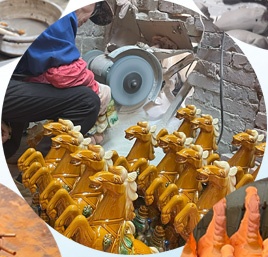
Removing Kiln Adhesions
During firing, the glaze becomes extremely fluid. Despite careful loading and the use of kiln furniture, small blobs of glaze may still drip onto the unglazed foot or bottom of a piece. These are carefully removed:
Small drips: Chipped away with a fine steel or stone tool
Stubborn drips: Ground down with a small abrasive stone
Kiln grit: Sand or ash that adhered to the glaze surface is gently scraped away
Care is taken not to damage the fired glaze surface. The goal is to leave the piece in the condition intended by the potter — no more, no less.
Cleaning
After removal of kiln adhesions, each piece is washed with water and a soft cloth or brush to remove any remaining dust or debris. Some museums and collectors prefer to leave a piece "as fired" with a light patina of kiln dust, believing this preserves its authenticity. Others prefer a thorough cleaning to reveal the glaze in its full brilliance.
Polishing (Optional)
On some Tang Sancai pieces, especially high-status figures intended for important tombs, the unglazed surfaces (feet, interiors of vessels) were lightly polished with a smooth stone or piece of leather. This gives the exposed bisque a slight sheen and makes it less prone to staining.
Cold Painting (Rare)
In a small number of Tang Sancai pieces, details such as facial features, jewelry, or textile patterns were added with cold pigments (pigments mixed with a binder but not fired). Because these pigments were not fused to the surface by heat, they are fragile and have often faded or completely disappeared over 1,300 years. When present on surviving pieces, cold-painted details are highly prized by collectors.
Quality Assessment: Grading the Finished Pieces
Tang Sancai pieces were produced for patrons who demanded the highest quality. Each finished piece was carefully inspected and graded.
First Quality (First-Class)
A first-quality piece meets all of the following criteria:
No structural defects: No cracks, chips, warping, or firing deformations
Complete glaze coverage: All intended areas fully covered; no bare spots
Proper color development: Colors are bright, clear, and true to their intended hues
Controlled flow: Glaze has flowed enough to create the characteristic "melted" look but not so much that details are obscured
No adhesion: The piece has not stuck to kiln furniture or neighboring pieces
No glaze defects: No crazing (fine cracks), shivering (flaking), pinholing (small pits), or devitrification (cloudiness)
First-quality pieces were destined for the tombs of high-ranking officials and nobles, or for presentation as imperial gifts.
Second Quality (Minor Defects)
A second-quality piece may show one or more minor defects that do not significantly detract from its appearance:
Small, unobtrusive chips (usually on the unglazed foot)
Minor crazing (fine network of surface cracks that does not penetrate the body)
Slight color variation from the intended hue
A small kiln adhesion mark in an inconspicuous location
Second-quality pieces were acceptable for lower-ranking patrons or for less prominent positions in a tomb.
Wasters (Discarded Pieces)
Pieces with major defects were discarded, either broken on the spot or — in some kiln sites — set aside in a discard pile. Common reasons for rejection include:
Cracks running through the body
Severe warping (often causing the piece to lean or collapse)
Glaze that ran off completely, leaving an unglazed body
Colors that burned out, leaving pale or colorless areas
Severe adhesion to kiln furniture (requiring destruction to remove)
These wasters are now prized by archaeologists because they provide direct evidence of ancient firing techniques and quality standards.
The Purpose: Beyond Beauty
It is important to remember that Tang Sancai was not primarily decorative art in the modern sense. Its original purpose was funerary — to accompany the deceased into the afterlife. The belief that "death is just another form of life" (事死如事生) meant that tombs were furnished with everything the deceased might need in the next world: food, drink, servants, musicians, and — for the military elite — horses, camels, and guardians.
The high quality of Tang Sancai reflects the importance placed on proper burial. These were not mass-produced souvenirs but custom-ordered grave goods, often commissioned by the family of the deceased. The cost of a full set of Tang Sancai figures could be enormous — equivalent to many months or even years of a common laborer's wages.
The Legacy of Tang Sancai Craftsmanship
The techniques developed by Tang Dynasty potters did not disappear with the fall of the dynasty. Instead, they influenced ceramic traditions across East Asia and, eventually, the world.
Influence on Later Chinese Ceramics
While Tang Sancai as a specific tradition declined after the Tang Dynasty (partly due to sumptuary laws that restricted lavish burials), its technical innovations lived on:
Lead-based low-temperature glazes continued to be used for architectural ceramics (roof tiles, ridge ornaments)
The use of metal oxides as coloring agents became standard in many glaze traditions
The two-stage (bisque then glaze) firing process was adopted and refined by later potters
Revival in the Modern Era
The modern revival of Tang Sancai began in the early 20th century, when archaeological discoveries near Luoyang brought these forgotten masterpieces to light. Artisans in the region, drawing on traditional skills passed down through generations of tile-makers and pottery craftsmen, began to reproduce Tang Sancai using ancient methods.
Today, the Tang Sancai firing technique is recognized as China's National Intangible Cultural Heritage (designated in 2008). Master artisans such as Gao Shuiwang have dedicated their lives to preserving and reviving the lost techniques of Tang-era potters, earning praise from experts at the British Museum for creating work that represents "not a restoration of a technique, but a dialogue with civilization."
The Living Tradition
The craft of Tang Sancai is not frozen in time. Contemporary artisans in Luoyang and elsewhere continue to innovate while respecting traditional methods:
New forms: Tea sets, lamps, jewelry, ornaments — functional objects for modern life
New colors: An expanded palette while maintaining the classic tri-color harmony
New markets: From museum-quality reproductions for collectors to affordable designs for tourists
New techniques: Modern kilns (gas, electric) provide more consistent results, though some purists still use traditional wood-fired mantou kilns
A satisfaction survey conducted among buyers of modern Tang Sancai products scored an average of 9.69 out of 10, demonstrating that the ancient art form continues to resonate with contemporary audiences.
Conclusion
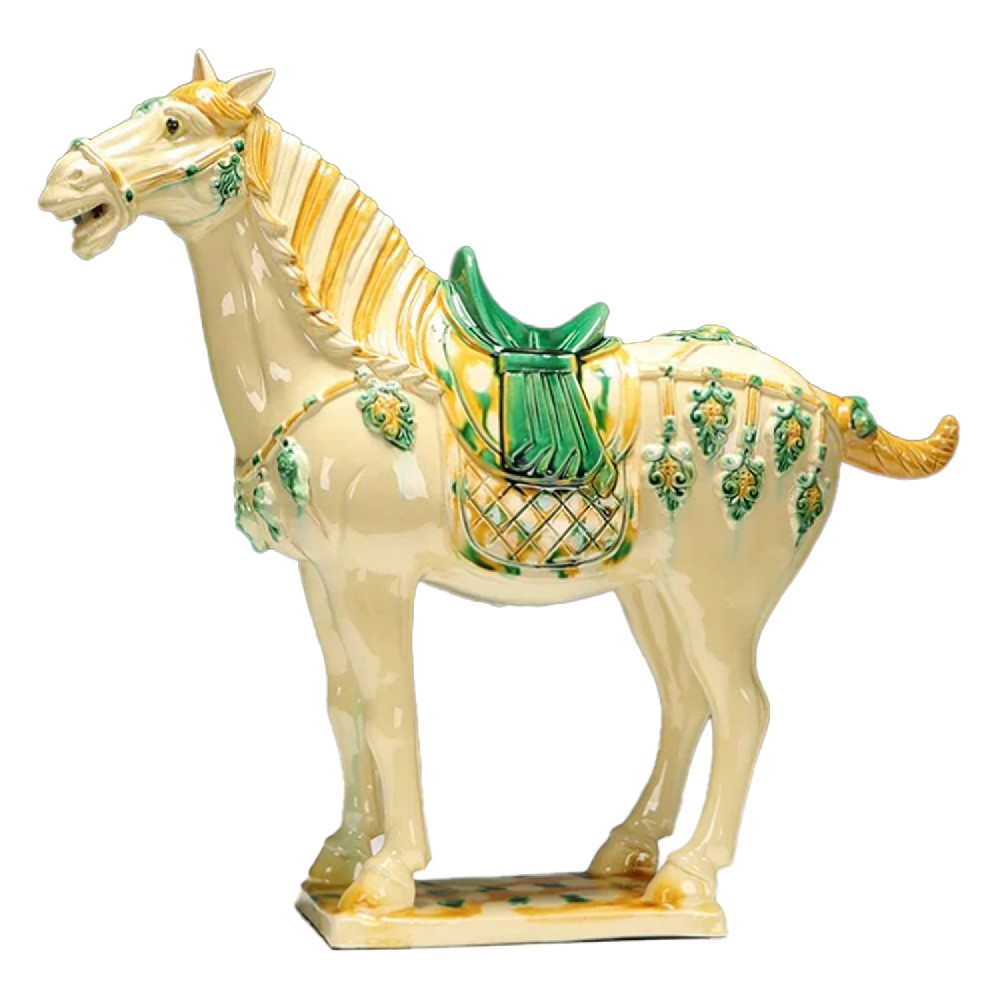
The craft of Tang Sancai is a remarkable achievement in the history of ceramic art. From the careful selection of clay, through the meticulous preparation of glazes, to the controlled chaos of the final firing, every step requires skill, knowledge, and patience. The surviving masterpieces — those horses, camels, and figures that now grace the world's greatest museums — are not just beautiful objects. They are the product of centuries of accumulated wisdom, the work of anonymous artisans who could never have imagined that their creations would still inspire awe more than a thousand years later.
The full craft of Tang Sancai can be summarized in seven essential stages:
Material Selection – Choosing the right clay with moderate iron content, high plasticity, and appropriate refractoriness
Clay Preparation – Crushing, sieving, washing, aging, and wedging to create a uniform, workable material
Shaping the Body – Molding, hand-modeling, or wheel-throwing, followed by trimming and decoration
Bisque Firing – First firing at 800–900°C to create a hard, porous body ready for glazing
Glaze Formulation – Mixing lead oxide, silica, clay, and metal oxides in precise proportions
Glaze Application – Pouring, dipping, brushing, and splashing to create the iconic flowing colors
Glaze Firing – The final firing to 800–850°C, where the glazes melt, flow, and transform
Each stage is a world of its own — a blend of science, art, and tradition. And together, they produce one of the most distinctive and beloved ceramic traditions the world has ever known.